
What Is GRC? Understanding Governance, Risk and Compliance
GRC stands for Governance, Risk and Compliance.
Three words that come up frequently in business, but which still tend to evoke too many Excel spreadsheets, complex procedures and endless audits.
Yet GRC is much simpler than it may seem.
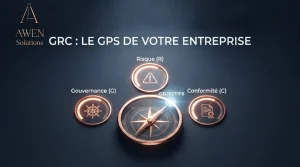
Think of it as a GPS for your business:
it tells you where you are going (Governance),
which obstacles to avoid (Risk),
and how to stay on the right side of the rules (Compliance).
For a large company, this may involve entire teams.
For an SME, it can start with a few good practices, clear responsibilities and a better understanding of its risks.
The goal of this article?
To answer one simple question: what is GRC, and why should an SME care about it?
1. GRC: Breaking Down the 3 Pillars
GRC stands for:
- G — Governance: Where are we going, and who makes the decisions?
- R — Risk: What could prevent us from getting there?
- C — Compliance: What rules and requirements do we need to follow?
These three dimensions are distinct, but inseparable.
GRC is about bringing them together so that a business can be managed with confidence and control.
GRC is not limited to a department or a checklist.
It is a holistic approach that runs across the entire organization,
from strategic decisions to day-to-day operations.
2. Governance: Who Decides, and How?
Governance is the way an organization is directed and managed.
It includes:
- roles and responsibilities;
- decision-making processes (who approves what?);
- internal policies (e.g. IT policy);
- controls and performance monitoring;
- the flow of information.
In a small business, governance may seem obvious:
“The owner makes the decisions, and employees carry them out.”
But as the company grows, more questions arise:
- Who can approve a new supplier?
- Who has access to customer data?
- Who can change a price?
- Who is responsible if a regulatory issue arises?
- Who needs to be informed in the event of an IT incident?
Governance is simply about knowing who does what, within which boundaries, and with what expected outcomes.
Governance does not mean creating more and more procedures.
It means clarifying responsibilities to avoid ambiguity and conflicts.
3. Risk: What If Things Go Wrong?
A business is constantly exposed to risks.
Some are obvious:
- a cyberattack;
- fraud;
- the loss of a key supplier;
- human error;
- a cash-flow problem.
Others are less visible… but just as real.
A practical example:
An SME relies on a single supplier for a critical component.
Everything has been working perfectly for five years.
Yet the risk exists: if that supplier disappeared tomorrow,
the company could be unable to manufacture or deliver its products.
A risk is not a current problem.
It is the possibility that a future event could affect your objectives.
GRC is precisely about anticipating these events before they occur.
4. Not All Risks Are Equal
Risk management is not about eliminating every risk (that would be impossible).
It is about:
- Identifying them;
- Analyzing them (likelihood + impact);
- Prioritizing them;
- Treating them (reduce, transfer, accept);
- Monitoring them.
Example using a simple table:
| Risk | Likelihood | Impact | Priority |
|---|---|---|---|
| Phishing (fraudulent email) | High | Medium | High |
| Loss of a critical supplier | Medium | High | High |
| Printer failure | High | Low | Low |
| Major regulatory non-compliance | Low to medium | Very high | Critical |
→ Conclusion:
Focus your resources on risks with high impact and/or high likelihood.
5. Compliance: Following the Rules, Yes… But Not Only That
A business rarely operates in a legal vacuum.
It may be subject to:
- European regulations (GDPR, PPWR, etc.);
- national laws;
- contractual obligations (customers, suppliers);
- industry standards;
- requirements relating to personal data or cybersecurity.
The real challenge?
Knowing which rules apply to YOUR business,
and then being able to demonstrate that you comply with them.
Modern compliance relies on auditability.
Compliance that cannot be demonstrated is fragile.
For example, if you say “We are GDPR compliant,”
what evidence can you provide?
(Assessment, procedures, documentation, controls, etc.)
6. Why the 3 Pillars Need to Work Together
Let’s take a practical example:
Your company uses software containing customer data.
- Governance: Who is responsible for this software? Who can decide to change providers?
- Risk: What happens if the provider suffers a cyberattack? What if the data is lost?
- Compliance: Which GDPR requirements apply? What data needs to be documented?
→ The three dimensions are connected.
A weakness in one can affect the others.
7. GRC as One Logical Chain
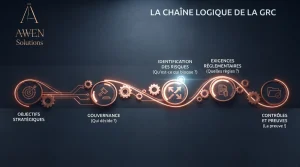
The logic of GRC can be summarized as follows:
Business objectives
↓
Governance (who decides?)
↓
Risk identification
↓
Regulatory and contractual requirements
↓
Controls and protective measures
↓
Evidence and documentation
↓
Monitoring and improvement
This is the chain that makes GRC operational.
8. “GRC Is Only for Large Companies”: True or False?
False.
An SME can be exposed to risks that are just as critical as those faced by a large company:
- processing personal data;
- online sales (legal requirements);
- importing/exporting products;
- dependence on a single supplier;
- use of cloud solutions;
- international expansion.
The difference?
The resources available to manage these risks.
An SME therefore needs to adopt a proportionate approach:
not a bureaucratic maze, but the right controls for the right risks.
9. GRC ≠ Red Tape: How to Keep It Simple and Effective
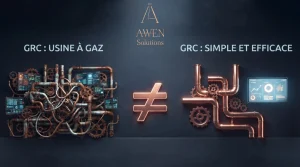
A poor approach to GRC consists of:
- creating unnecessary procedures;
- building endless spreadsheets;
- holding never-ending meetings.
A good approach is to:
- Identify the risks that genuinely matter to your business;
- Put in place only the controls that are actually necessary;
- Document what matters (not everything).
The goal is not to have 200 procedures.
It is to have the right procedures for the right risks.
10. A Practical GRC Approach for an SME
Here is how to get started simply:
- Understand your business: activities, customers, suppliers, data, tools.
- Identify your obligations: which regulations apply to you?
- Identify your risks: what could go wrong?
- Assess the risks: which ones are the most critical?
- Review existing controls: what are you already doing?
- Identify gaps: what is missing?
- Build an action plan: where should you start?
- Document: what evidence should you retain?
- Monitor: are actions being completed? Have the risks changed?
→ GRC is a cycle, not a one-off project.
11. GRC vs. Cybersecurity: What’s the Difference?
Cybersecurity focuses on protecting systems, data and infrastructure against digital threats.
GRC takes a broader view:
it includes cybersecurity, but also:
- regulatory risks;
- supplier risks;
- operational risks;
- contractual risks;
- product-related risks.
→ Cybersecurity can be a component of GRC, but it is not the whole of GRC.
12. GRC vs. Regulation: They Are Not the Same Thing
Compliance is part of GRC, but GRC goes beyond compliance.
A company can meet all its regulatory obligations and still be:
- poorly prepared for a cyberattack;
- vulnerable to the loss of a supplier;
- unable to cope with a business interruption.
→ GRC allows you to look at the entire system, not just tick the boxes.
13. The Real Goal: A More Resilient Business
GRC should not be viewed as:
“Yet another requirement we have to comply with.”
Instead, it should be viewed as:
“How can we make our business better able to anticipate, make decisions, withstand disruption and demonstrate that we are managing our risks effectively?”
A sound GRC approach can help to:
- reduce incidents;
- improve processes;
- secure suppliers;
- facilitate international expansion;
- better prepare for audits;
- avoid commercial roadblocks;
- protect data;
- clarify responsibilities.
Compliance can become a business enabler.
It should not be viewed as a constraint, but as a competitive advantage.
14. The 5-Question Test to Get Started
To assess your GRC maturity, ask yourself these 5 questions:
- Where do we want to go? (Governance)
- What could prevent us from getting there? (Risk)
- What rules and requirements do we need to follow? (Compliance)
- How do we know that we are managing these risks effectively? (Controls and evidence)
- How do we know that our framework remains effective? (Monitoring)
→ If you cannot answer some of these questions, you have already identified your first GRC priorities.
15. GRC in One Sentence
GRC enables an organization to better govern its activities,
identify and manage its risks,
and meet the requirements that apply to it —
while being able to demonstrate what it is doing.
For an SME, this does not mean building a complex organization.
It mainly means:
understand → prioritize → act → document → control → improve.
Conclusion: What’s Next?
GRC may seem like something reserved for large organizations or experts.
In reality, its principles are useful to any business that wants to grow in a structured way.
The more a company grows, the more it accumulates:
customers, suppliers, employees, data, tools, countries and regulatory requirements.
Complexity increases.
GRC helps bring structure to that complexity.
Compliance is not an end in itself.
It is one of the foundations that enables a business to build something solid, sustainable and under control.
This is precisely the approach that guides Awen Solutions:
making GRC understandable, proportionate and directly actionable for businesses.
Going Further
This article is “Level 0” in your understanding of GRC.
To go deeper, we recommend these articles:
- → How to Build a Risk Map
- → How to Conduct a Compliance Assessment
- → How to Set Up an Effective Regulatory Watch
- → GRC and Cybersecurity: Where Should an SME Start?
Then, to go even further, explore our regulatory articles:
- PPWR: The Complete Guide for Businesses
- GDPR: How to Comply Simply
- AI Act: What Businesses Need to Know
Our goal?
To make Awen Solutions the place where a business leader comes to understand what they need to do,
rather than simply a website that republishes regulatory news.

Leave a Reply